Explicit job contract
Objectives, constraints, required evidence, allowed tools, action boundaries, and completion checks remain visible throughout the run. A repair attempt works against the same contract instead of inventing an easier target.
CR Lite Syndicate
CR Lite executes governed work, evaluates it against explicit checks, and reports the result with evidence and an honest delivery standing. It can improve a result without hiding what remains unverified, blocked, or failed. The operator chooses the objective, constraints, checks, and action boundaries; the runtime keeps those decisions attached to the work as it moves through the circuit.
The model produces. Independent deterministic checks evaluate. CR Lite repairs, records standing, and returns the strongest candidate.
$ cr-lite run "review release notes"
{
  "standing": "verified",
  "stanceReview": "supported"
}
This is one illustrative verified case. It is not a promise that every run verifies or produces a deliverable.
What CR Lite builds
CR Lite turns the job into a bounded circuit: roles, inputs, tools, checks, repair limits, evidence, and action gates. The circuit can be small for one answer or coordinated across specialist blocks when the work requires different kinds of judgment.
Objectives, constraints, required evidence, allowed tools, action boundaries, and completion checks remain visible throughout the run. A repair attempt works against the same contract instead of inventing an easier target.
Deterministic checks and gathered evidence evaluate the work. Requirements, schemas, tests, source support, and tool results can each contribute evidence. A model opinion cannot overwrite a failed authoritative check.
Failures return specific guidance to the producing block while preserving the failing evidence. Attempt, cost, and time limits stop the circuit from repairing forever or hiding an unresolved problem behind repeated generation.
Reading and analysis can proceed under the approved policy. Saving, exporting, committing, deploying, spending, sending, or changing a connected system can require explicit approval and a recorded action result.
Execution and checking
Every stage has a defined responsibility. Producing, checking, repairing, and reporting remain separate so the final receipt can show what happened and what still needs judgment.
Give it an objective, relevant context, constraints, and the checks that should govern the result. Define required evidence, acceptable tools, action limits, and the conditions for completion. The job remains explicit instead of drifting with the conversation or quietly changing during repair.
CR Lite selects the blocks, tools, skills, and scoped memory needed for the job, then records how they fit together. Read-only work can proceed while consequential actions remain gated. The circuit preserves handoffs and intermediate evidence so a later reviewer can understand how the candidate was produced.
Independent deterministic checks evaluate requirements, structure, code, sources, secrets, and tool results. Failed checks become targeted repair guidance instead of being replaced by a favorable model opinion. Repair remains bounded by attempt, cost, and action limits, and unresolved failures remain visible in the receipt.
The run returns the strongest candidate it found, supporting evidence, unresolved issues, and an honest delivery standing. When no viable deliverable exists, blocked or failed can say so directly. The receipt separates what ran, what checks established, and what still requires human judgment before another action.
Delivery truth
A viable strongest candidate is preserved when one exists. Verification quality is not confused with delivery, and a difficult result is not renamed to make the run look successful.
The standing answers whether CR Lite can release a candidate and under what conditions. Evidence in the same receipt explains which requirements were checked, which checks failed, and whether any output is partial, blocked, or absent.
verified | completed | best_effort | blocked | failed
Standing is release and delivery truth. stanceReview is independent source-support/conflict review, not delivery status. Deterministic failures remain authoritative.
failed may include the strongest derived output, but it does not guarantee that an output exists. blocked can also return no deliverable.
Lowercase verified is not Certification Garage certification. Certification outcomes are job-specific and separate from CR Lite delivery standing.
A source review may report support or conflict while deterministic execution still fails. The source review cannot reverse that failure.
Workbench and workloads
Inputs can be objectives, data, events, APIs, repositories, records, and connected systems. Outputs can be artifacts, decisions, transactions, system updates, reports, code, or downstream actions.
Reading client files from a folder and depositing a finished artifact is one shipped workflow example, not the product boundary. The same governance model applies when work begins or ends somewhere else.
A work circuit can begin from a human objective, repository change, scheduled event, incoming record, or connected API. What matters is that inputs, checks, decisions, and authorized actions remain explicit enough to inspect after the run.
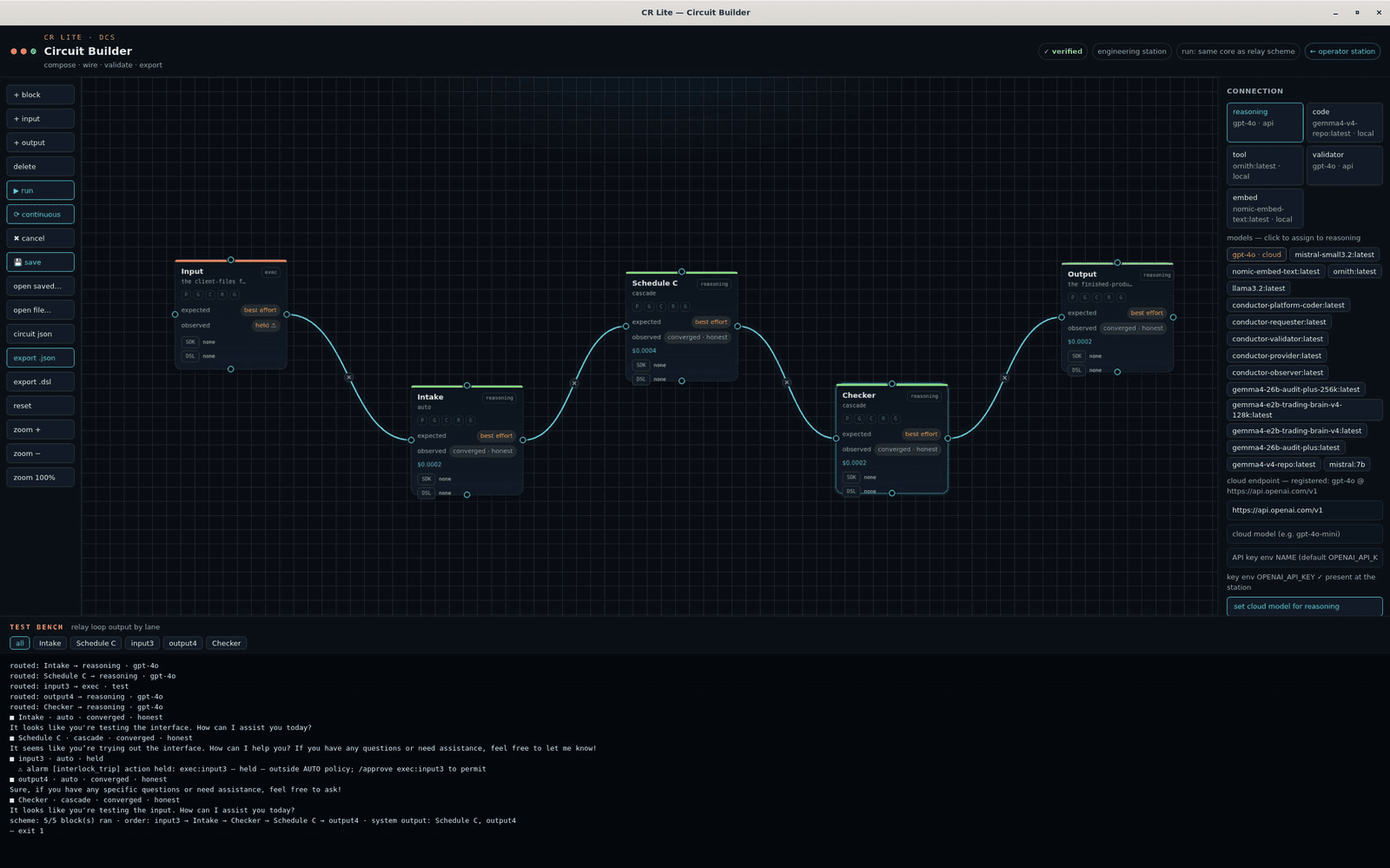
Gather sources, distinguish direct evidence from inference, compare support and conflict, repair unsupported claims, and return a report with citations, unresolved questions, and evidence that another person can review.
Inspect a repository, identify the affected surfaces, make scoped changes, run explicit checks, explain the diff, and preserve compiler, test, security, or policy failures instead of talking past them.
Transform structured inputs, validate schemas, relationships, and required fields, record exceptions and rejected records, and return the strongest usable artifact with its limitations and validation evidence.
Coordinate approved APIs and tools, carry evidence across handoffs, pause before consequential actions, and return decisions, system updates, or downstream actions with a reviewable audit trail.
Hosted demo and local license
The hosted demo uses controlled scenarios and does not accept private repositories or arbitrary customer code. The paid local license runs CR Lite on your machine; external tools connect only under your configuration and approval.